
· by Michael Blair, Nashville's Fence Company
People pick a fence height for their dog and then find the dog got out some other way. Dogs leave a fenced yard by climbing, jumping, digging under the fence, chewing through it or learning to open the gate, as Humane World for Animals’ guide to dogs that run away lists them, and the fix depends on which of those your dog does.
What fence height holds a dog?
In our experience four feet holds plenty of small or easygoing dogs and few determined ones, and six feet is what we suggest for most breeds. Height has a limit, though. The same Humane World guide says some dogs jump fences but most climb them, pushing off from some part of the fence, and for those it recommends an extension that tilts inward at about 45 degrees; the angle matters more than how much height it adds.
Owners often ask whether privacy boards help because the dog can’t see the street. In a 2017 survey published in the Journal of the American Veterinary Medical Association, dogs kept behind see-through fences and dogs behind privacy fences had escaped at the same rate, 23.3 percent each, so blocking the view is no stand-in for enough height and a sound base.
Stopping the digging
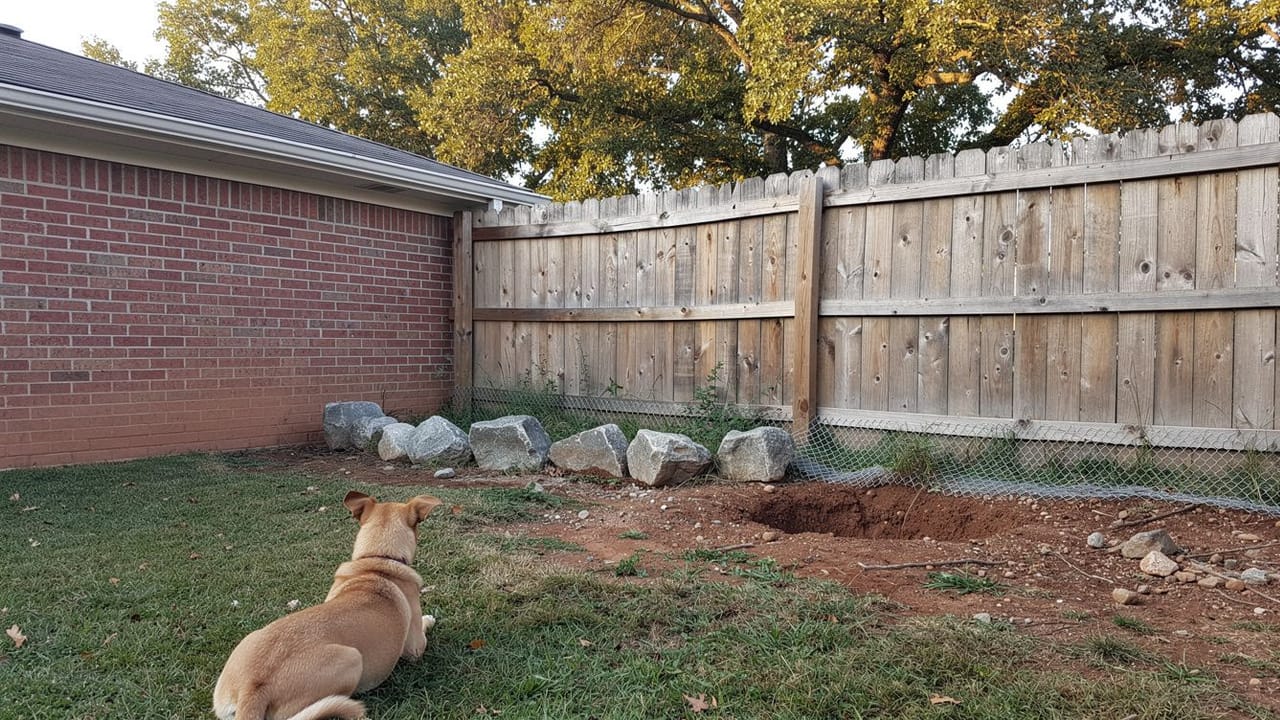
Holes under or along the fence usually mean the dog is digging to get out, according to Humane World’s guide to dogs that dig. Its fixes all work at the base: chicken wire buried at the foot of the fence, large rocks partly buried along the bottom, the bottom of the fence set 1 to 2 feet below the surface, or chain-link fabric laid flat on the ground and anchored to the bottom of the fence so the dog doesn’t like standing there.
Of those, the flat apron is the easiest to add to a fence that is already up, since no post has to come out of the ground, and a roll of chain link fabric does the job. Humane World also makes the point that none of this works as well until you know why the dog wants out, because a bored or lonely dog will keep testing whatever you put in.
- Six feet for most breeds, with an inward-tilted extension for climbers
- Buried wire, partly buried rocks or a flat chain-link apron at the base
- No gaps larger than the dog can push through
- A gate that closes and latches on its own, with the latch out of the dog’s reach
- Nothing a dog can use as a step within reach of the fence
Gates and the things beside fences
Humane World counts learning to open a gate among the ways dogs get out, and a gate somebody left open does the same thing. A self-closing hinge and a latch mounted high on the outside take both of those out of the picture. If your gate has dropped and no longer catches, our post on a gate that sags explains why, and new gates and hardware are part of what we install.
Then look at what sits next to the fence. The running-away guide warns against anything near it a dog could use as a springboard, naming a table, a chair and a doghouse, and in a Nashville backyard a wood pile, an air conditioner or a raised bed serves a dog just as well.
Do invisible fences keep dogs in?
These systems put a device on the dog’s collar that shocks it at a set boundary, and the dogs in the JAVMA survey that were kept in this way were the most likely to have gotten out: 44 percent of them had escaped, against 23.3 percent behind a physical fence. The study’s authors put it down to motivation, since a dog can cross when the urge to chase prey or a perceived intruder outweighs its reluctance to take the shock, and getting back into the yard means crossing that same boundary.
The only equipment is on your own dog, so nothing stops a loose dog, wildlife or a person walking into the yard, which counts for a lot on a front yard beside a sidewalk. If you are weighing one against a real fence, ask us for a free estimate on the fence and compare.
Sources
- Humane World for Animals, Keep your dog from running away by knowing why they escape — How dogs escape (most climb rather than jump; dig, chew, open gates); inward extension at about 45 degrees; nothing near the fence to use as a springboard; find the motive first
- Humane World for Animals, How to get your dog to stop digging — Digging under or along a fence means escape; buried chicken wire, partly buried rocks, fence bottom 1 to 2 feet down, chain link laid on the ground and anchored to the fence
- Starinsky, Lord and Herron, Escape rates and biting histories of dogs confined to their owner’s property through the use of various containment methods, JAVMA 250(3):297-302 (2017) — Escape rates: electronic fence 44.0 percent, see-through and privacy fences 23.3 percent each; how electronic fences work and why dogs cross them
FAQ
Fencing That Actually Contains a Dog — questions
How tall should a fence be for a dog?
Six feet is what we suggest for most breeds, and four feet is enough only for small or easygoing dogs. Most dogs that get over a fence climb it instead of clearing it in one jump, so for a climber an extension that tilts inward at about 45 degrees does more than extra height.
How do I stop a dog digging under the fence?
Work at the base. Bury chicken wire at the foot of the fence, partly bury large rocks along the bottom, set the bottom of the fence 1 to 2 feet into the ground, or lay chain-link fabric flat on the ground and anchor it to the bottom of the fence. It also helps to find out why the dog wants out, since a bored dog keeps testing whatever you install.
Are invisible fences a good alternative?
They hold some dogs and lose others. In a 2017 survey published in the Journal of the American Veterinary Medical Association, 44 percent of dogs kept in by an electronic fence had escaped at some point, compared with about 23 percent behind a see-through or privacy fence. The collar also does nothing to keep other dogs, wildlife or people out of the yard.
Can dogs climb fences?
Yes, and most dogs that get over a fence climb it rather than jump it, pushing off some part of it, according to Humane World for Animals. An extension tilted inward at about 45 degrees stops climbers better than added height, and anything near the fence a dog could use as a step, such as a woodpile, should move.