
· by Michael Blair, Nashville's Fence Company
A fence that keeps a dog in the yard and a fence that keeps a toddler out of the water are measured by different rules. In Davidson County the second kind is tied to the pool, not the fence: an ordinary fence needs no permit, but a pool does, and the pool permit points straight to the barrier section of the pool code. That is why a fence that looks fine around a yard can come up short around a pool. This post walks through what Metro asks for, what the federal safety guidelines say a barrier should do, and the details that most often fail on an existing fence. The fence itself is usually ornamental aluminum, for reasons that come down to those details.
The pool permit is what brings the fence into it
Metro Codes’ pool permitting page lists what goes in with a residential pool application: the permit application itself, a receipt for a pool alarm, and a site plan showing the pool and its pump and filter with their distances to property lines and easements. A pool cannot sit in an easement or a platted setback, and the zoning examiner works from a checklist. On the barrier, the page does not give dimensions. It says the fencing requirements are found in the International Swimming Pool and Spa Code, Section 305, and it gives the building division’s number, 615-862-6550, for questions.
Which edition matters. Metro’s adopted codes list shows the 2024 International Swimming Pool and Spa Code in force with local amendments, and the Metro news release on the 2024 codes says the ordinance took effect July 16, 2025, for plans and applications submitted on or after that date. We have not seen Metro’s amendments to the barrier section, so we do not quote code numbers as Metro’s rule here. The exact requirements for your pool come from Metro Codes through the permit, and that is the document a fence built for the pool has to satisfy. A plain yard fence is a different matter, covered in our post on whether a fence needs a permit in Nashville.
What the safety guidelines say a barrier has to do
The clearest published description of a residential pool barrier is the CPSC’s Safety Barrier Guidelines for Residential Pools. The commission is explicit that the guidelines are not a CPSC standard and are not mandatory; it notes that some states and localities have written them into their codes. Read the figures below as CPSC’s guidelines, not as Metro’s requirements. They are still the right way to think about what a pool fence is for: slowing a small child down long enough for an adult to notice.
The guidelines put the top of the barrier at least 48 inches above grade, measured on the side facing away from the pool, and note that some places require 60. The gap underneath should be no more than 4 inches, or 2 inches over grass or loose stone. No opening anywhere in the barrier should let a 4-inch sphere pass. A solid barrier should offer no handholds or footholds. Most of what goes wrong with an existing fence is in that last line and in the rails.
- Height: 48 inches or more, measured on the outside
- Under the bottom: 4 inches at most, 2 over grass or gravel
- Any opening: smaller than a 4-inch sphere
- Outside face: nothing a child can climb
Rails, pickets and mesh: where ordinary fences fail
A horizontal rail is a ladder rung. The CPSC guidelines say that when horizontal members are less than 45 inches apart, measured from the top of one to the top of the next, they belong on the pool side and the vertical spacing between pickets should be no more than 1¾ inches. A six-foot wood privacy fence with three rails has its rails well under 45 inches apart. Metro’s fence rules put cross beams on the interior of the property, which for a pool in the back yard is usually the pool side, so a fence we build for a client sits the right way round. The trouble comes with a neighbor’s fence used as one side of the enclosure: its rails face their yard, and from there it is a climb straight down to your water.
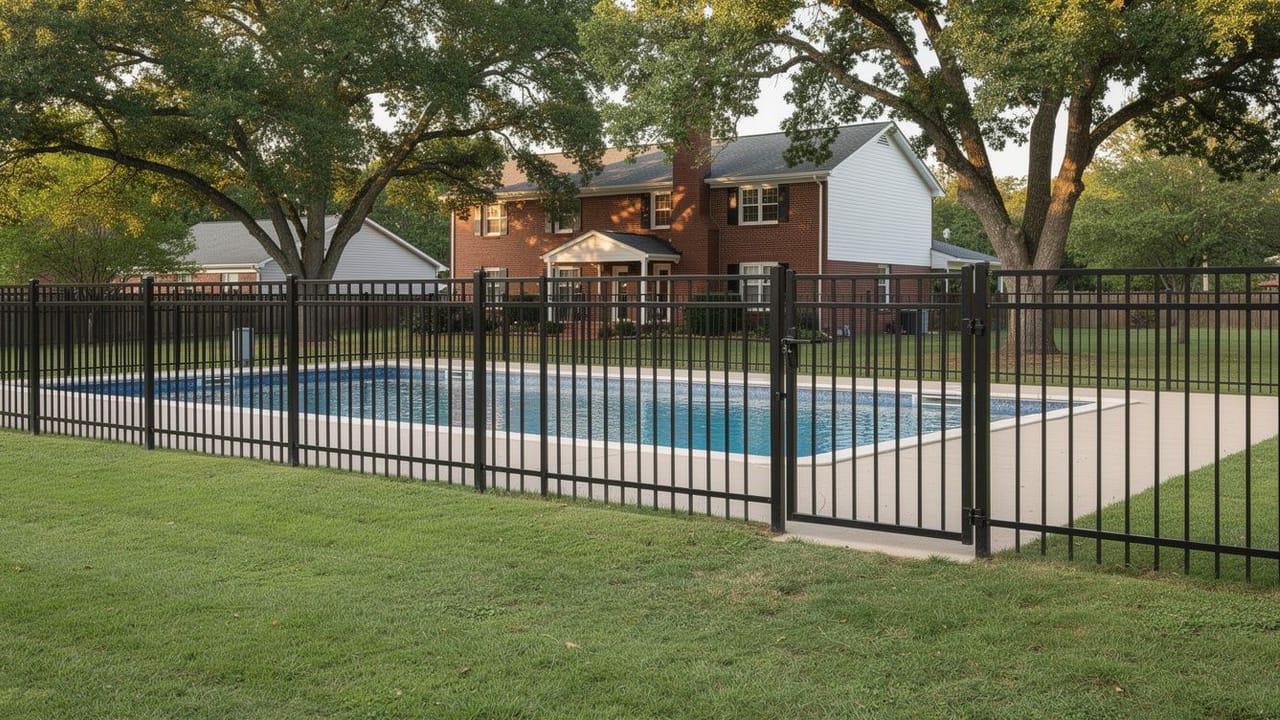
Aluminum is the usual answer because the geometry is easy to get right. The pickets are vertical, the spacing is set at the factory, and the finished face has nothing to step on. It still has rails, though. On a style where the top and bottom rails are close together, the 1¾-inch picket spacing in the guidelines applies, and a wider-spaced decorative style may not suit a pool. We check the panel against the permit before ordering, not after. Chain link can serve, but CPSC puts its mesh at no more than 1¼ inches square unless slats bring the openings down to 1¾ inches or less; a typical yard chain link is worth measuring before anyone assumes it qualifies. For the wider trade-offs between materials, see our comparison of wood, vinyl and aluminum fencing.
The gate, the house wall and the clay underneath
The gate is the part of a pool fence used every day, so it is the part that fails first. Under the CPSC guidelines a pedestrian gate opens outward, away from the pool, and closes and latches by itself. If the latch release is less than 54 inches above the bottom of the gate, it should be on the pool side, at least 3 inches below the top, and there should be no opening larger than ½ inch within 18 inches of it, so a child cannot reach through and lift it. We hang and adjust gates with this in mind: a self-closing hinge that will not pull the gate fully shut from every open position is a gate that stands open.
Middle Tennessee clay works against that gate. It swells wet and shrinks dry, and a gate post that moves a fraction of an inch is enough to make a self-latching gate stop catching, which is the same problem described in our post on a gate that sags and will not latch. On a pool gate we set the hinge and latch posts deeper and check the swing after the first dry spell. Where the house forms one side of the enclosure, the guidelines call for alarms on the doors that open toward the pool, a power safety cover meeting ASTM F1346, or equal protection.
Tennessee adds its own alarm rule. UT MTAS’s summary of the state pool alarm law explains that a residential pool installed or substantially altered on or after January 1, 2011 must have an alarm, and that no permit is issued without one; public and multi-family pools are outside it. The alarm is in addition to the barrier, not a substitute for it. If you are planning a pool or replacing the fence around one in Nashville, send us the permit details or the site plan and we will price a fence built to them.
Sources
- Metro Nashville Codes, Pool Permitting — Application, pool alarm receipt and site plan; barrier requirements in the International Swimming Pool Code, Section 305
- Metro Nashville Codes, Adopted Codes List — 2024 International Swimming Pool and Spa Code adopted with local amendments
- Metro Nashville, Metro Adopts 2024 International Building Codes — Effective July 16, 2025, for plans and applications submitted on or after that date
- U.S. Consumer Product Safety Commission, Safety Barrier Guidelines for Residential Pools (Pub. 362) — Voluntary guidelines: height, gaps, rails, chain link mesh, gates and house walls
- UT MTAS, Swimming Pool Alarms (MTAS-337) — T.C.A. 68-14-801 to 807: alarm required on pools installed or substantially altered on or after January 1, 2011