
· by Michael Blair, Nashville's Fence Company
We compare these materials by what each one asks of you once the fence is up. Sun and water do the wearing: the USDA Forest Products Laboratory’s chapter on finishing wood says weathering can be as much a factor as decay in how long decks and fences last, and Nashville gets about 50.5 inches of precipitation in a normal year, according to the National Weather Service’s Nashville climate page. What a fence costs depends on the length of the run, the gates and the ground, and our cost guide goes through those, so this post sticks to the years after install.
How much upkeep does a wood fence need?
Wood looks the warmest and takes the most looking after. Pressure-treated pine is often still wet when it goes up: the finishing chapter says treated lumber is sometimes above its saturation point when it is delivered and installed, and the laboratory’s chapter on drying and dimensional change traces warp to a board shrinking by different amounts along and across its grain as it dries, with surface checks opening early in drying. For cedar against pine, the finishing chapter says naturally durable species and preservative-treated wood have quite comparable service lives above ground, and that a finish which slows moisture movement limits checking, splitting and warp in either one. Below ground it calls for pressure-treated lumber, or the dark heartwood of a naturally durable species, on every post and any other part in contact with the soil.
Clear sealer is the shortest-lived finish. The chapter gives a water-repellent preservative only 1 to 2 years as a natural finish, depending on the wood and its exposure, though it calls reapplying one on a fence easy. Penetrating stains need recoating more often than paint, and solid-color stains form a film that can peel the way paint does. Our post on staining a wood fence covers when new boards are ready for a first coat. Where wood earns its keep is a repair: when one board splits, we replace that board and leave the rest of the section alone.
How do you maintain a vinyl fence?
Vinyl’s upkeep is washing. Illusions, a vinyl fence maker, recommends a non-abrasive cleaner such as car wash soap, used with a soft cloth or brush, for normal maintenance, and warns that the wrong cleaners or washers can easily damage the surface. The privacy and picket styles we put up are on our vinyl fence page.
Pick the color carefully, because it is meant to stay. On the same maker’s colored and woodgrain lines the finish is bonded to the fence at a molecular level, and a touch-up marker or bottle comes with every order in case of a mark. Before buying any vinyl, ask what standard it was made to. The Illusions installation guide says its fence meets ASTM F964-13, and that the PVC compound has to keep a minimum impact resistance after six months and a year of weathering in a hot dry climate, a hot humid one and a temperate northern one. Any supplier should be able to show you its F964 certification.
Aluminum and steel
Ornamental aluminum marks a boundary without closing it in, which suits a pool or a front yard. Around a pool it is also a barrier under code: Metro’s pool permitting page says the barrier and fencing requirements for pools are in the International Swimming Pool Code, and our post on when a fence counts as a pool barrier goes through what that asks of the fence.
Steel, in an ornamental fence or a chain link frame, lasts as long as its coating does. Ameristar, which makes chain link framework, describes its PermaCoat framework as galvanized steel under a fused epoxy base coat and a polyester top coat, warranted for 15 years against cracking, chipping, peeling, blistering and corroding, and says its pre-galvanized GalvOnAll framework will not rust from the inside, a point it makes against traditional in-line galvanized framework. That is a manufacturer describing its own product, but the lesson carries to any steel fence: a scratch or a cut end through the coating is worth touching up.
Neither gives privacy, which for many Nashville back yards is the point of the fence.
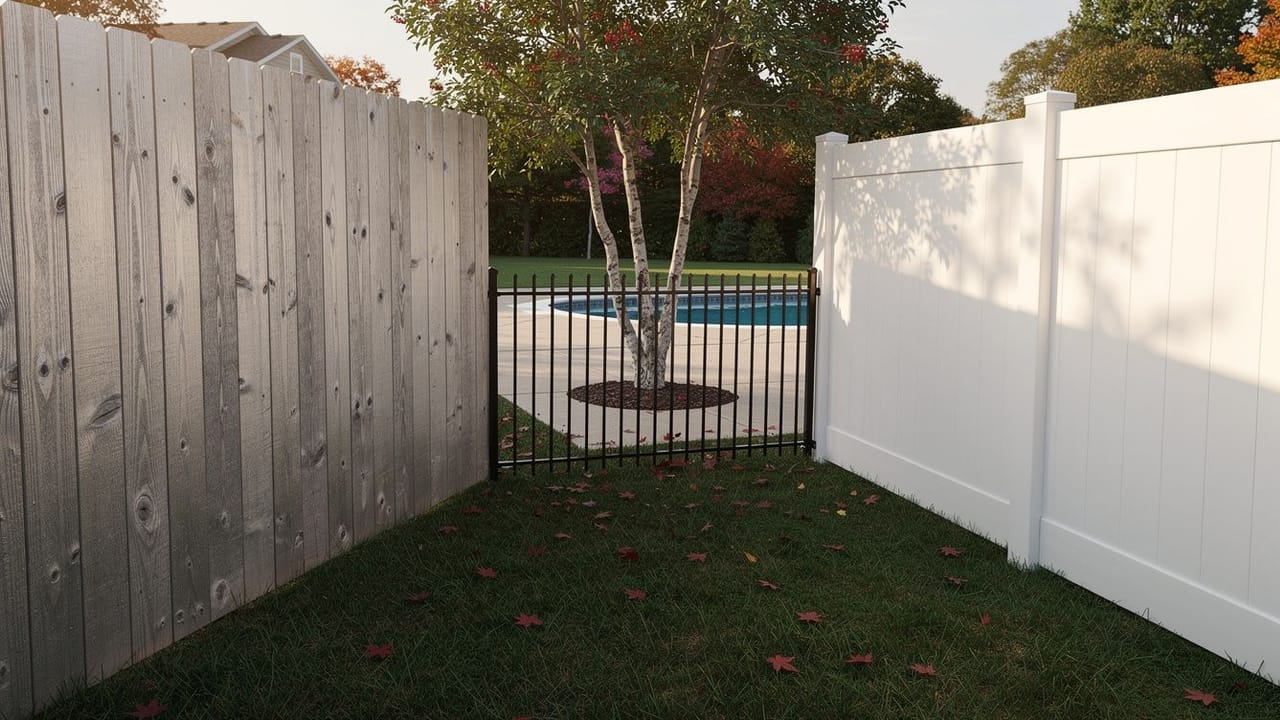
- Wood: the warmest look, a clear finish to renew every year or two, single boards replaceable
- Vinyl: washed with mild soap, color chosen once, ask for the ASTM F964 certification
- Aluminum: open sight lines, no privacy, used for pool barriers
- Steel and chain link: galvanized steel whose life rides on its coating
What decides it locally
Privacy requirement first. If you need it, that means wood or vinyl, and where the fence runs matters: Metro Codes’ fence rules hold a solid fence to 30 inches within the 10-foot front setback, while an open fence such as chain link or wrought iron can reach 72 inches there, and a fence beside or behind the house can go to 8 feet. Then be honest about how much upkeep you will do. Penetrating finishes lose their water repellency, turn gray and develop mildew as they weather, the finishing chapter says, and bare wood first shows color change and slight checking.
Check any HOA or neighborhood rules before choosing. Metro’s page calls its rules general ones and says zoning overlays and homeowners’ associations may add restrictions of their own. When you have narrowed it down, ask us for a free estimate and we will price the materials you are weighing on your own run.
Sources
- USDA Forest Products Laboratory, Wood Handbook (FPL-GTR-282) Chapter 16: Finishing Wood (Hunt, 2021) — Weathering as much a factor as decay for decks and fences; treated lumber sometimes installed wet; durable and treated woods comparable above ground; finishes limit checking, splitting and warp; treated lumber or durable heartwood for ground contact; clear water-repellent finish lasts 1 to 2 years; penetrating finishes recoated more often than paint; solid-color stains peel like paint; weathered finishes gray and mildew
- USDA Forest Products Laboratory, Wood Handbook (FPL-GTR-282) Chapter 13: Drying and Control of Moisture Content and Dimensional Changes (Bergman, 2021) — Warp from differing shrinkage across and along the grain as wood dries; surface checks early in drying
- National Weather Service Nashville, Nashville climate — Normal annual precipitation of 50.51 inches
- Illusions Vinyl Fence, FAQs — Car wash soap with a soft cloth or brush for normal maintenance; wrong cleaners or washers can damage it; color bonded at a molecular level on colored lines; touch-up supplied with every order
- Illusions Vinyl Fence, Installation Instructions (February 2024), Material Specifications — Meets ASTM F964-13; minimum impact resistance after six months and one year of weathering in hot dry, hot humid and temperate northern climates
- Metro Nashville Codes, Pool Permitting — Pool barrier and fencing requirements are in the International Swimming Pool Code
- Ameristar Perimeter Security, PermaCoat chain link framework — Galvanized steel under an epoxy base coat and polyester top coat; 15-year warranty against cracking, chipping, peeling, blistering and corroding
- Ameristar Perimeter Security, GalvOnAll chain link framework — Pre-galvanized steel framework that will not rust from the inside, compared with traditional in-line galvanized framework
- Metro Nashville Codes, Building Permits Central: I Want to Build a Fence (updated January 17, 2025) — Solid fences 30 inches and open fences 72 inches within the 10-foot front setback; 8 feet beside or behind the house; cross beams and bracing face the interior, not the street or an adjacent property; zoning overlays and HOAs may add restrictions
FAQ
Wood, Vinyl or Aluminum Fencing Here — questions
How long does a wood fence last in Middle Tennessee?
We have not found a reliable source that gives one figure for a fence here, and we would rather not make one up. What the USDA Forest Products Laboratory does say is where a fence wears: posts and other parts in the ground face decay and termites and should be pressure-treated or the dark heartwood of a naturally durable species, and weathering from sun and rain can matter as much as decay to how long a fence lasts. Above ground, a finish that slows moisture movement cuts down checking, splitting and warp in the boards.
Is vinyl fencing worth it over wood?
It comes down to the upkeep you will really do. The USDA Forest Products Laboratory gives a clear water-repellent finish on wood only 1 to 2 years, while one vinyl maker’s maintenance advice is car wash soap and a soft cloth or brush. Wood can be stained or painted a different color later; on colored vinyl the finish is bonded to the fence, so you live with the color you pick. Prices depend on the run, so compare the two on a quote for your own yard.
Which side of the fence faces my neighbor?
In Nashville it is more than a convention. Metro Codes requires a fence’s cross beams and cross bracing to face the interior of the property, not the street or an adjacent property, which leaves the smooth side facing out toward your neighbor. A homeowners’ association or a zoning overlay can add rules of its own, so check your covenants before building, and it is worth a word with the neighbor regardless.
What type of fence is best?
The one that fits what the fence is for and the upkeep you will really do. Privacy means wood or vinyl, within Metro’s height limits; wood needs refinishing, while vinyl needs washing. Aluminum marks a boundary and suits a pool, and steel lasts as long as its coating. Check HOA and overlay rules before choosing.