
· by Michael Blair, Nashville's Fence Company
Fence rules in Nashville come from up to three places at once, and satisfying one does not satisfy the others. Metro is the first of them, and its answer to the permit question is shorter than most people expect. The other two, a homeowners’ association and a historic overlay, are where a fence that met every city rule can still end up being rebuilt.
Does Metro require a permit for a fence?
Metro does not currently require a permit for a residential fence. The fence page at Metro Codes’ Building Permits Central says residents adding one must meet zoning and building code requirements but are not required to obtain a permit “at this time.” That page was last updated in January 2025, so read it again before you build.
What Metro does regulate is height and placement. Within the first 10 feet of the front setback, a solid fence can be no taller than 30 inches, while an open style such as chain link or wrought iron can reach 72 inches. From there to the front of the house the limit is 6 feet, and beside or behind the house it is 8 feet. An alley does not count as a street for the setback, and Metro wants cross beams and bracing facing into your own yard, never toward the street or the neighbor.
Corner lots carry the tightest rule: no fence at all inside the 35-foot visibility zone, although Metro exempts corner lots inside the Urban Zoning Overlay. Ask Metro Codes when you are unsure rather than going by what a neighbor built, since a fence that has stood for years tells you nothing about whether it met the rule.
Metro sets no minimum distance between a fence and the neighboring property line, and it does not decide where that line is; a dispute over it is a civil matter. That side of the question is covered in our post on fences, property lines and neighbors.
HOA covenants
Metro’s fence page notes that a homeowners’ association may have further restrictions, and it leaves those to you. Associations write their own rules, so the covenants for your subdivision are the only reliable answer. Read them for material, color, height and which way the finished side has to face, and for whatever approval process they lay out.
Get any approval in writing before materials are ordered, and make it name what was approved. We would rather wait a week for a letter than put up a fence the board has to vote on afterward.
- Confirm Metro’s height limit for each part of the yard
- Look up overlays on the parcel in Parcel Viewer
- Get HOA approval in writing before ordering
- Keep clear of the 35-foot visibility zone on a corner lot
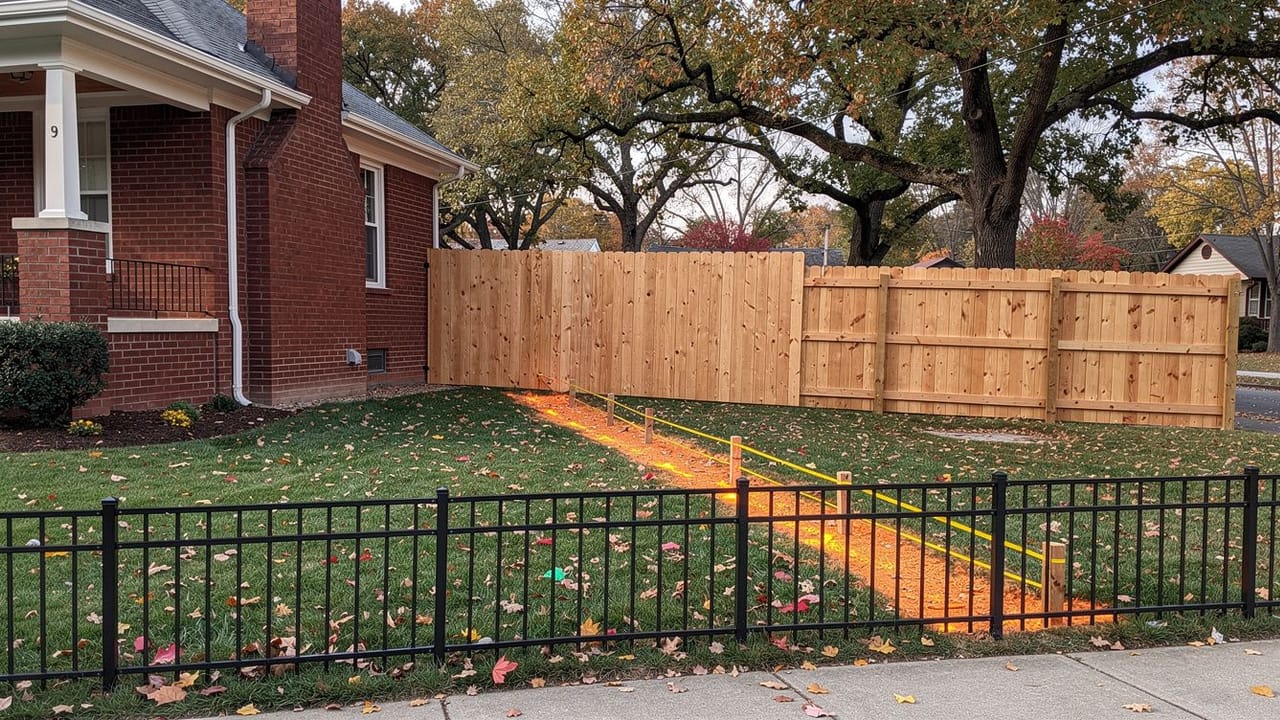
- Request a Tennessee811 locate at least three working days ahead
Does a historic overlay change the fence rules?
A property in a Historic Preservation or Historic Landmark Overlay needs a Preservation Permit before a fence goes up, and Metro sends owners to the Historic Zoning Commission for it. A Neighborhood Conservation overlay works differently: Metro says fencing there does not require a Preservation Permit.
To find out which applies, Metro points to its Parcel Viewer, where the zoning tab shows any overlay on the parcel. A lot inside a Specific Plan or the Urban Design Overlay may have location or material requirements of its own, and those questions go to the Planning Department. We look the parcel up before we quote a fence in Nashville and Davidson County, because an overlay is far easier to deal with before the lumber is on order.
Utilities and easements
Tennessee requires a locate ticket before any digging. The Tennessee Public Utility Commission’s underground damage prevention page says each person responsible for excavating must get one from Tennessee811 at least three, and no more than ten, working days before starting, that utilities then have three business days to mark, and that there is no charge for the request. When we set the posts, the ticket is ours to request. Post holes can reach buried gas, power, water and fiber lines, and the commission’s page says damage that lets gas escape must be reported through 911 at once.
Easements are the other trap. Metro allows a fence over an easement, but if a utility needs to get in, the homeowner is responsible for rebuilding whatever it takes down. Metro Codes does not keep easement records, so the recorded plat, a title abstract or a survey is where to look. If you want us to walk your lot with these rules in hand, ask for a free estimate.
Sources
- Metro Nashville Department of Codes and Building Safety, Fence (Building Permits Central) — No permit required at this time; height limits by setback; 35-foot corner visibility zone and UZO exemption; cross bracing faces inward; HOA and overlay restrictions; Preservation Permit in Historic Preservation and Landmark overlays, not Conservation overlays; Parcel Viewer; SP and UDO to Planning; easements and rebuilding; no line distance; property line disputes are civil
- Tennessee Public Utility Commission, Underground Utility Damage Prevention — Locate ticket from Tennessee811 required before excavating; three to ten working days’ notice; three business days to mark; no charge; gas release reported through 911
FAQ
Do You Need a Permit for a Fence in Nashville — questions
Do I need a permit for a backyard fence in Nashville?
Not at this time. Metro Codes says a residential fence must meet zoning and building code requirements but does not need a permit. The height limits, the 35-foot visibility zone on corner lots and any HOA covenants still apply, and a property in a Historic Preservation or Historic Landmark Overlay needs a Preservation Permit from the Historic Zoning Commission.
Do I have to call 811 before digging fence posts?
Yes. Tennessee law requires a locate ticket from Tennessee811 before excavating, and requesting one is free. The Tennessee Public Utility Commission says to make the request at least three and no more than ten working days before digging, so put it on the calendar well ahead of the day you planned to set posts.
Can my HOA make me take a fence down?
That turns on your covenants and how your association enforces them, which is not something Metro decides; its fence page only says associations may have further restrictions. Written approval before building, specific about material, height, color and orientation, is the best protection we know of.
Do I need a permit to replace an existing fence?
Not from Metro at this time, though the new fence has to meet zoning and building code. It is held to today’s height limits and corner-lot rule, not to whatever the old fence got away with. A Historic Preservation or Landmark overlay still requires a Preservation Permit, and any new post holes need a Tennessee811 ticket.