
· by Michael Blair, Nashville's Fence Company
Nashville yards slope, often steeply, and a fence has to follow the ground. There are two ways to do that. A racked fence lets the rails angle with the grade so the pickets stay vertical and the bottom follows the ground closely. A stepped fence keeps each panel level and drops each one down like a stair. They look different, cost differently, and only one of them keeps a small dog in.
Racking
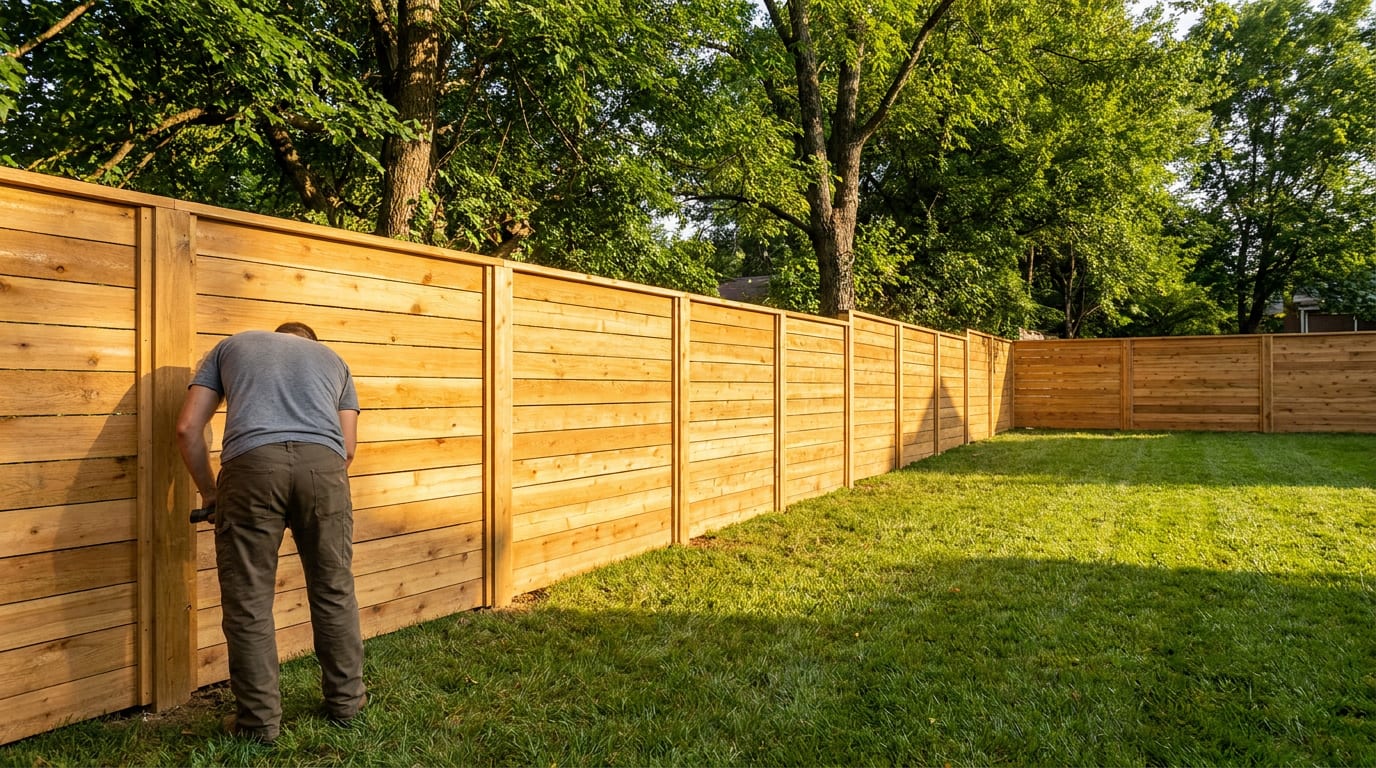
In a racked fence the horizontal rails run parallel to the slope and the pickets are attached vertically to them, so the top of the fence follows the hill in a smooth line and the bottom stays a consistent distance off the ground. On a wood fence built on site, that is simply how the fence is assembled: rails follow the grade, pickets are cut to length at the top.
Racking handles gentle and moderate slopes well. As the grade steepens, the rails start to angle sharply and the pickets, which are attached square to a rail that is no longer level, need more fastening to keep from parallelogramming. Beyond a certain pitch the fence looks strained and stepping becomes the better answer.
Stepping
A stepped fence keeps each section level between posts and drops the next section to follow the grade. The top is a series of horizontal lines rather than one sloping one. It suits pre-built panels, which cannot rack, and it suits very steep ground where racking would look wrong.
The cost of stepping is the triangle of open space under the low end of every panel. On a steep slope with long panels those gaps are big enough for a dog or a child, and they have to be closed with a kickboard, extra pickets cut to the ground, or a low retaining course. That work adds up, and it is the reason a stepped fence on a steep lot is often more expensive than a racked one despite using cheaper panels.
- Racked: smooth top line, consistent bottom gap, wood or rackable panels only
- Stepped: level panels, stair-step top, gaps beneath each panel to close
- Shorter post spacing reduces the gaps on a stepped fence
- Kickboards close the gaps and also keep pickets off the ground
What each material allows
Site-built wood racks naturally. Vinyl and aluminum come as panels, and a standard panel racks only a little; most manufacturers make a rackable version with slotted rails that can handle a moderate slope, and sell it as such. Beyond that they step. Chain link racks to almost any slope because the mesh simply stretches diagonally.
Composite and many privacy-style vinyl panels do not rack at all, and a supplier who says a slope is no problem with those products is planning to step them. Ask how the bottom gaps will be closed and get it on the drawing.
Posts, drainage and the bottom of the hill
Whichever method, posts are set plumb, never leaning with the slope, and set deeper on a hill than on flat ground because the downhill side has less soil holding them. In our clay, a post at the bottom of a slope sits where water collects, and it rots first. Gravel under the post and a concrete collar that sheds water away from the wood, rather than a cup that holds it, matter more there than anywhere else on the run.
Water moves downhill along a fence line and a solid privacy fence across a slope becomes a dam. Leave the bottom clear of grade by a couple of inches, or fit a gravel strip, so runoff passes under rather than pooling against the pickets on the uphill side.