
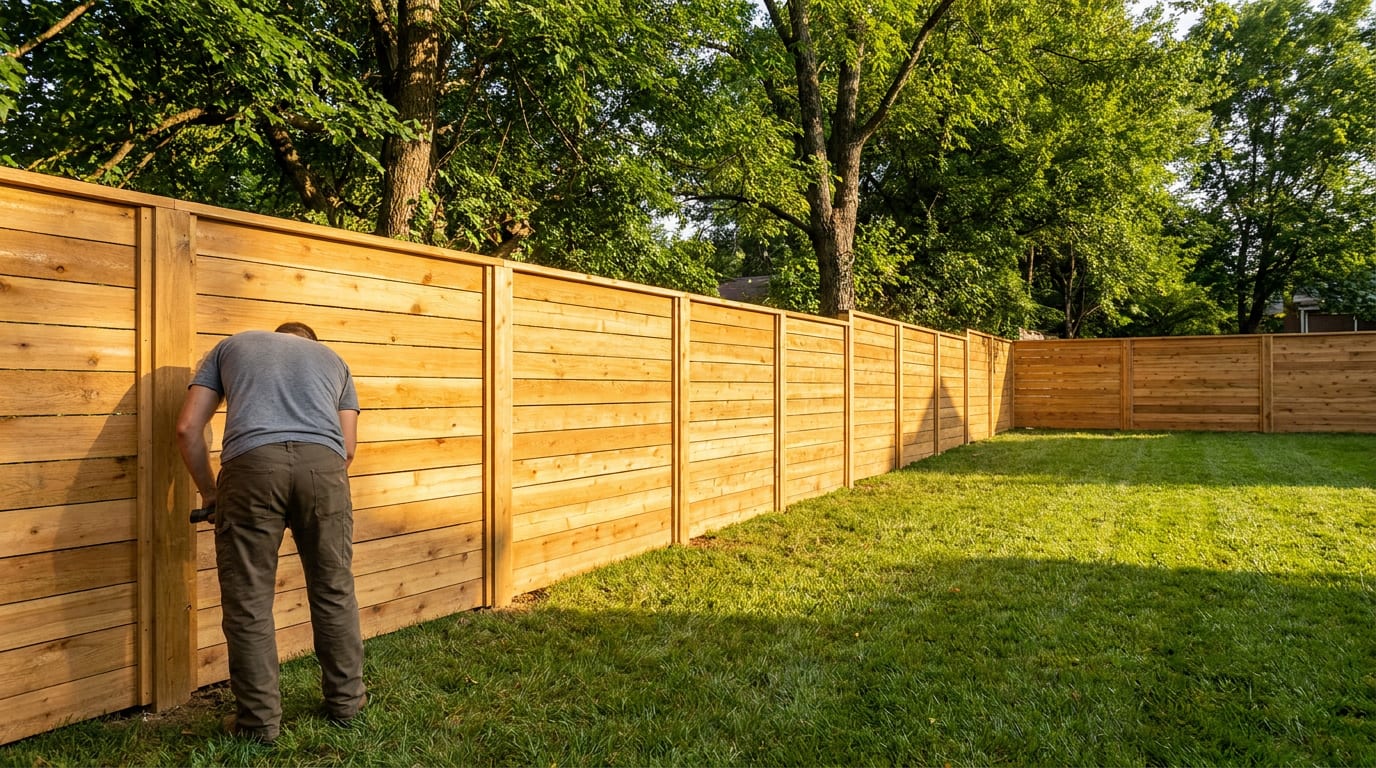
· by Michael Blair, Nashville's Fence Company
A wood privacy fence in Middle Tennessee does not fail all at once. A post leans after a wet spring, a section blows down in a storm, boards at the bottom go soft where the mulch touches them. Each of those is a small repair on its own, and each one raises the same question: keep patching, or start over. The honest answer depends less on how the fence looks than on the condition of the posts and how many more repairs the fence has in it.
What repairs well
Boards and pickets are the easiest part of a fence to replace, and a run of new boards on old rails is a routine job. Rails that have rotted at the ends can be replaced or sistered. A gate that sags is a hardware and bracing fix. A single post that has rotted at grade can be pulled and reset, or a new post sunk next to it and the panels reattached.
One or two sections blown over in a storm, on a fence that is otherwise sound, are worth standing back up. The test is whether the posts on either side of the damage are still solid; if they are, the repair holds.
What does not
Posts are where a fence dies. In our clay, a post sits in a hole that holds water, and the wood at and just below grade stays wet for months at a time. Once several posts are soft at the base, replacing them one at a time means digging next to a fence that is falling apart around each new post, and the panels between them are usually on their last years anyway.
A fence where the boards are gray, cupped and cracking across most of its length, where more than a few posts move when pushed, or where previous repairs have left a patchwork of new and old boards is past the point where another repair buys much. Each patch on that fence looks worse than the last and costs about the same.
- Push each post at the top: movement means the base has gone
- Probe the post at grade with a screwdriver: soft wood is rot
- Count the sections that have been repaired already
- Look at the bottom rail and the board ends near the ground
A rough rule for deciding
If the posts are sound and the damage is confined to a few sections, repair. If more than about a third of the posts are compromised, or the repair list has grown to the point where a contractor is quoting it by the section rather than by the piece, replacement is usually the better spend, because the labor of piecemeal work on a failing fence adds up to the labor of a new one without the new fence at the end.
The age of the fence tells you something too. Pressure-treated pine fencing in this climate typically gives somewhere in the range of fifteen to twenty years with staining and some care, less without. A fence at the end of that range with rotting posts is not a candidate for repair; it is a fence that has done its job.
If you replace, fix what killed the old one
A new fence set the same way as the old one fails the same way. Posts should be set with gravel at the bottom of the hole so water drains rather than pooling in the concrete cup, and the concrete should be crowned above grade to shed water away from the wood. Steel posts, which several fence companies now offer with wood panels, take the rot question off the table entirely.
Keep the bottom of the boards off the ground, keep mulch and soil from piling against them, and stain the fence in its first year and every few years after. Most of what shortened the old fence was water at the base, and most of it was avoidable.